samedi 7 avril 2012

Jamaica - Cayman

In Jamaica, you need to know two expressions "no problem" and "yamaannn". So no trouble there at all. The excursions were well organized. First, the Dunn's River Falls, which we had to climb! It was much fun, and of course so refreshing.The next excursion was the Skyland, the local skilift, which runs through the tropical forest. Nice too to be on top of the trees.
Tropical forest also means tropical animals. I had to be fast on that one: a hummingbird!
Next stop: Cayman Island. There again, some tropical animals: the stingrays! Apparently, that picture is the most commonly taken in the Cayman. Am I a tourist or not?
At least, I am a sporty tourist! I did kayaking. Not so tiring, but you have to make sure to be synchronized. Easier said than done...
The funniest thing was this "flip-flop tree". Last year, a couple from Cayman got really annoyed at seeing so many flip-flops abandoned on local beaches that, one night, they collected them and nailed them down on that tree. Since then, tourists stop by that tree and add their own flip-flops.
After the kayaking, time to relax and snorkel! Another first for me. Nice to swim around and to look for fishes.
Do not ask me for their scientific names... just admire the fishes!

jeudi 5 avril 2012

Cruise in the Caribbean

This huge cruise ship was home for five days. It was not with little apprehension that I boarded the "Carnival Destiny", since this boat is owned by the same company, which lost two ships in recent months. But once you step on the boat, everything is forgotten. As the cruise manager Noonan said, "what happens on this ship stays on this ship".
The deck was the place to be, with its swimming pools, its inviting chairs (so nice to watch a movie there - even if the program includes ET...), its minigolf course, its basketball field, its table tennis area.
Inside the ship was like a huge building with 10 stores. Of course, there was a huge number of rooms to accommodate the 3000 passengers. I must admit that I was positively surprised at how diverse the passengers were. Anyway, on each floor, there was so much on offer: fitness, casino, bars, stage, shops, medical center, restaurants, library.
There was always something to do, whether it is to eat (and believe me, some people ate almost 24 hours a day...), drink, play at the casino, laugh at a comedy show, being taken in picture, cheer at a cabaret, anything so that passengers would have FUN ! Still, all in all, the best was to relax and sunbath on a beach chair.
The 1000-people strong crew was well trained to make you feel welcome. Everyday, the cleaner would create a "towel animal". Most employees were from Asia and Eastern Europe, while the captain was an Italian.

mercredi 21 mars 2012

Kyrgyz Republic

After a long flight and a jetlag of eleven hours, time to arrive in Bishkek, the capital of the Kyrgyz Republic, where I was welcomed by the snow... The city boasts many "Soviet-style" buildings and monuments, as well as wide boulevards, but at least is surrounded by a high mountain range. It felt nice to wake up and see white mountains in the background.
This trip was primarily for work purposes. Many meetings with the main economic actors in the country. It was so interesting to see how the country authorities work, their policies, their challenges. One of the more attractive building is the Parliament, which was previously the seat of the government.
And the authorities were very welcoming, with many good dinners, where I had to quickly become an expert at vodka toasting! At this farewell dinner, we were also entertained by musician. One was playing accordion (is traditional music the same throughout the world...) and another one was singing in Kyrgyz, which sounds very Turkish.The welcoming extended to a private visit to the secret golden chamber of the National Museum to admire the pieces of golden Kyrgyz art. Gold remains the main export of the country.This tradition of being a good host even extended to organise excursions both on a public holiday and on the week-end. The first one took us to the Orlovka ski resort, owned and operated by a Swiss, what a surprise! Swiss flags dotted the whole resort, while the support staff was wearing jackets with the "Graubunden" logo. We had much fun on the slopes. Especially me, since they were not the steepest in the world.
The second excursion was to the big Issyk-Kul lake. The combination lake-mountain cannot be unfamiliar to a Swiss visitor. Even more so, when we passed by the huge and protected residence of the Kazakh president - are we on the shores of Lake Geneva?

mercredi 14 mars 2012

Istanbul

Ok, to treat Istanbul as a stopover between America and Asia might be a little bit harsh, but in this case, it is exactly what it was. Still, you can try to make the best of a stopover. The obvious choices are to eat a shawarma on Taksim square, to walk along the Bosphorus, to count the number of stray cats, and to resist buying a carpet... Compared to my first visit around 15 years ago, the city is even bigger, but seemingly less chaotic. Difficult to say whether it has become more conservative.The two most famous landmarks are the Blue Mosque and Hagia Sophia. The first one was built in the 17th century in the classical Ottoman style.
Next to it, Hagia Sophia was first an orthodox church built in the 6th century, and during a thousand year the biggest church in the world (before the Spanish built a bigger one in Sevilla). It was converted to a mosque in the 15th century, once the town had been conquered by the Ottomans. Many Christian characteristics were then removed and replaced with Islamic features. To this day, it is still a very impressive building!

vendredi 20 janvier 2012

Costa Rica

Any entry about Costa Rica should start with "pura vida" - the country's motto, actually more than that - a way of life: so enjoy life! And the next thing to mention is the name of the Costa Ricans: they call themselves the "Ticos". So there it is: welcome to Costa Rica.
Costa Rica is a land of peace. The capital city is dotted with statues of doves (is that not much nicer than cows...!!). There are also many signs praising previous President Arias, who obtained the Nobel Peace Prize in 1987. At least, these doves add a certain specificity to the otherwise unremarkable capital city. Guidebooks, friends and even neighbors on the plane warned about pickpockets. But the only thief we witnessed was a raccoon who maliciously stole a packet a chips from unsuspecting American tourists on the beach! Good laugh.
Costa Rica is a small country, Ticos are short, and the animal are also small. During a two hour long walk through the most famous national park, the guide "succeeded" in pointing a frog, a lizard, an iguana, and finally a sloth! More than that - a moving sloth. Good to see it hang high up the tree.
Although small, Costa Rica offers a great variety of landscape. The beaches are superb, and the Atlantic Ocean was so enjoyable to swim in. Perfect temperature, and nice little waves to play with.
Of course, the volcanoes are probably the main specificity of Costa Rica - there are three of them on the country's coat of arms. Some of them are still active, like this one at Poas. The guidebook advises to get there before 10am, and believe me, you have to get there before 10am. The lake in the volcano is surprisingly cool, at 40 degrees. The fumes prove the volcano is alive. Great to see all of this, and to feel the earth "breathing". Even more so, when, after a fifteen minute round walk in the forest, coming back to the volcano, it was completely hidden behind a thick layer of fog. I felt quite bad for all the tourists (including the Japanese ones, who were late for once) who were walking up towards the volcano and would not see ANYTHING...
The tropical forest is very dense, but sometimes there is a beautiful opening, like this waterfall.
And sometimes, there is an even better one, like this frog! Certainly one of my best picture ever.

dimanche 4 décembre 2011

Mexico/Maya sites

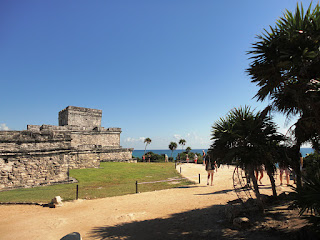
The Yucatan peninsula is famously known as the home of the Maya, whose civilization dominated the region from around 1500 AD until the arrival of the Spanish. There are still many sites around the Peninsula. The first I visited might very well have been one of the first the Spanish saw, since it is located by the sea in Tulum. Indeed this town was still thriving when the Spanish arrived. This site is quite compact once passing through a breach in the protecting wall.
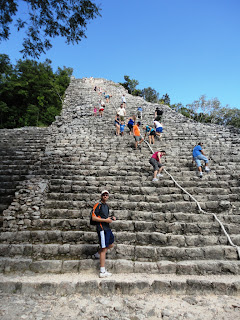
Going inland, the site of Coba boasts the highest point of the whole Peninsula! It is at the top of the Maya-made pyramid. The Nohoch Mul is 42 meters high and a steep climb - the way down is worse... From the top, one sees how flat the area is, with the jungle extending to the horizon.
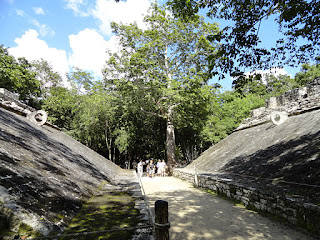
The Mayas had also their sport - here the place where they played the ball game. It consisted of sending a heavy rubber ball through the two circles, without touching the ball with neither the hands nor the feet. Why make things so complicated? The Mayas were also very interested with astronomy and built many observatories. They developed a complex set of calendar, with short and long cycles. The sun and Venus played a central part in their knowledge of the sky and also in the design of their temples - the number of stairs, or the number of snakes on a temple would be defined by the calendar.
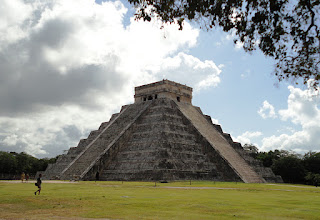
Perhaps, the most famous Maya monument in Yucatan is the pyramid of Chichen-Itza. The pyramid is "only" 25 meters high, yet beautifully located and well reconstructed. It looks very simple, yet the number of stairs, platforms, stone panels all reflect sacred numbers. Even more, at the equinoxes, the ray of the sun form a snake descending the pyramid. Great design.
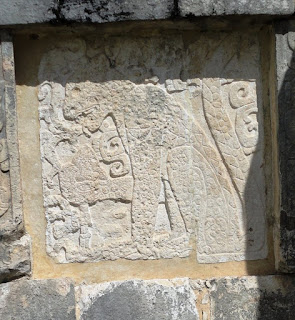
Chichen Itza has many other temples. One is dedicated to the jaguars.
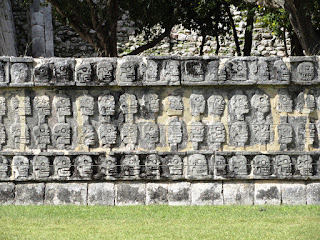
Another one, more scarier, is a "tzompantli" or "skull rack". It is a platform where the victim's heads were displayed. A tribute also to the military function of the town.
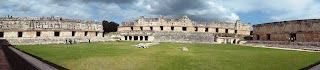
My favorite site might well have been Uxmal. The square of the Nunnery (as erroneously named by the Spanish) is a magnificient complex of four buildings enclosing a plaza. Some historians think that this complex might have been a earthly paradise, where future sacrificial victims would spend their final months in debauchery. The facade are richly decorated with religious symbols, including many snakes and rain Gods.
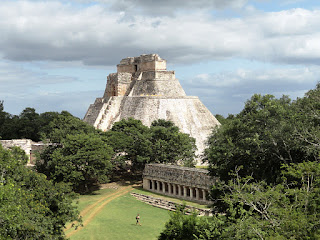
This complex lies next to the pyramid of the magician. It is a surprising pyramid, with an unique oval base. Some historians argue that it is because it was wrongly rebuilt... One thing that is certain is that the "final version" was built on top of five earlier temples. Still it looks majestic.
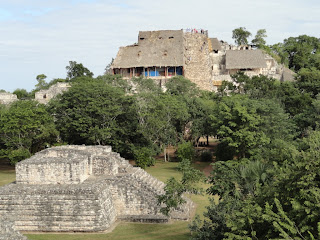
Ek-Balam was by far the least visited site, quite wrongly so. Its Acopolis is massive, and they are still uncovering statues, sculptures and bas-reliefs. At the moment, thatched roofs protect them.
I must admit that the sites are very well maintained, the explanations quite good - they even started a sms service, with information at each site. The vendors were not intrusive - except maybe in Chichen Itza, where the fake cry of the jaguars was hurting our ears too often. In most sites, they had restaurant and coffee areas, with a good product placement by Nespresso.

Mexico/Yucatan

The first visit in Mexico was actually the Sian Ka'an biosphere reserve. It is situated around a shallow lagoon. The boat ride in the lagoon was nice, but the best was floating on the life-jacket down a little stream thanks to a gentle current for around 2 kilometers. Thankfully, the crocodiles stay in the lagoon and do not venture in the stream. The guide reminded me that in these tropical latitudes, the tide is almost non-existent. So the salty water does not push much upstream. Bad luck for the crocodiles.
The Atlantic Ocean, or Caribbean sea, was also nice and warm, certainly around 25 degrees Celcius. But, since I am not an American tourist, I did not spend all my time by the beach. It was indeed interesting to observe that the further you go away from the sea (Cancun and Playa del Carmen), the less American tourists you encounter. The "cultural" tourists are mostly from Continental Europe.
A good surprise was the state of the roads. Hardly a pothole, good signs, normal speed limits (maximum 110 km/h), calm drivers, no policemen, and an almost deserted toll road. The only hindrance were the many many speed bumps. They obviously had an impact.
Churches are more numerous than Maya temples. There are usually located on the main square, this one in Valladolid. The town itself has many one/two floors typically Spanish buildings, beautifully restored and colored. There is definitely a colonial feel to the town.
This one is actually a convent (of San Antonio de Padua), and can be seen from all corners of the little town of Izamal. It was built on the remains of a Maya pyramid, whose top was chopped off by the Spanish chopped in 1552.
This last one is in Merida - it is white and a bit austere, like the one in Valladolid. During the Mexican revolution, the cathedral was entirely looted. It towers over the main square (unfortunately in renovation at the moment).
On another side of the main square, the palace of the state's government. Inside, there are many large paintings depicting the main events of the Mexican history. Unfortunately, these paintings have a very strong socialist/revolutionary/nationalistic undertone. In Valladolid (see below), it is the local government building which sits on the main square. It is ornamented with the Mexican coat of arms of the eagle devouring a snake. Besides beauties above ground, there are more than 10000 caves filled with water in the Yucatan peninsula. This one was easily accessible in Valladolid.In conclusion, I must say it was nice to travel in a country where all the scales are "normal" - meters, km/h, degrees Celcius, kilograms. Welcome to Mexico !