OK, OK, holidays do not always have to be abroad... am I really saying that?? Yes, there are nice things to see in my own country. I must thank my foreign friends to come and visit, so that I can discover my own country as well. Although it must be said that I have been to all the 26 cantons/provinces.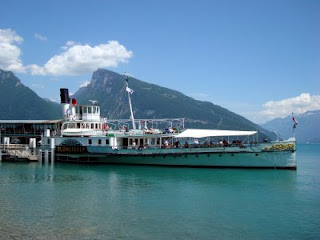
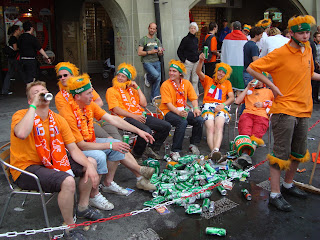
This time, we went on a cruise on the little Lake of Thun (of course, I have to say "little" compared to our big Lake of Geneva). Sunny, quiet, relaxing. We also walked along the Lake and I must say that everything is well organised and made for everybody to feel at ease. Of course, there were still the odd Dutch tourists wearing orange T-shirt. 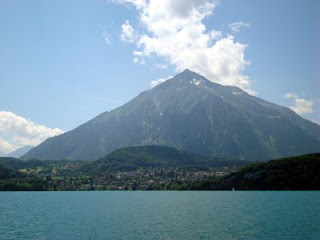 Then we took the funicular up the Niesen. The tourist office calls this mountain "the Pyramid of Switzerland". The ride up is quite a challenge. There is a board explaining how steep the climb is and how the technology improved over the years to make it a faster ride.
 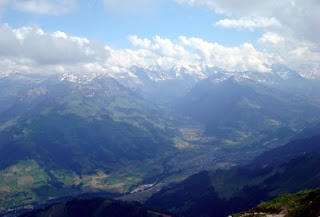 And from the top, the view over the Lake and over the mountains is breathtaking. Everywhere you look and it is beautiful. Come and see for yourself!
Then we took the funicular up the Niesen. The tourist office calls this mountain "the Pyramid of Switzerland". The ride up is quite a challenge. There is a board explaining how steep the climb is and how the technology improved over the years to make it a faster ride. And from the top, the view over the Lake and over the mountains is breathtaking. Everywhere you look and it is beautiful. Come and see for yourself!


 But is this really a surprise... The president's picture is all over the place. He is keeping a watchful eye on its people. Nevertheless, the presence of the security apparatus is not as visible as in Egypt. We travelled throughout the country and never were stopped by the police.


 Then, there was a period of constant conflicts between the Muslims and the Christians. The most famous symbol is the Krak des Chevaliers. It was build between 1050-1250. It very impressively dominates the whole region and was a key post for the Christian Crusaders on the way to Jerusalem. It is a huge fortress with an outside wall and its 13 towers and the castle itself. Inside, it is like a town made for around 2000 people, with a church, stables, baths, warehouses with supplies to last for 5 years and of course, many rooms. This castle was actually never conquered. Indeed in 1271, the Muslims surrounded the castle, which had become the last outpost of the retreating Christians. So after a month of siege, the Crusaders agreed to abandon it, in exchange for a safe escape.
 Approximately at the same time, in Aleppo, the second city, the Muslims built and reinforced the Citadel. The walls and the main doors are impressive. It is a big and as solid as any of the Crusader's castles.
 A last example of the new techologies invented by the Muslims are the norias - wooden water wheels. They are more than 20 meters high and were used to scoop water from the Orontes river and deposit it into aqueducts. A very efficient way to irrigate the neighbouring areas.

 Let's keep the best for last: Palmyra. I do not think I have ever seen such an extended and well preserved site as this one. Maybe it is also the fact that it is in the middle of the desert, next to an oasis.
 The Romans gave large freedom to the free city. The local people were allowed to build a temple in honour of their God, Bel. The temple is in the middle of a huge courtyard, where many sacrificial animals were killed. The temple itself is very well preserved. It is also noteworthy that it was later transformed into a church and a mosque. Local families were still living on the premises until the 1930's. A hotel - where we stayed - was constructed by the French almost on the ruins. Our guide told us that he hopes this hotel will soon be destroyed. Selfishly, it is true that it is an unforgetful experience to have breakfast in the middle of this splendour, but this is not the best way to preserve the site.


